Cheap parts, one shared Wi‑Fi
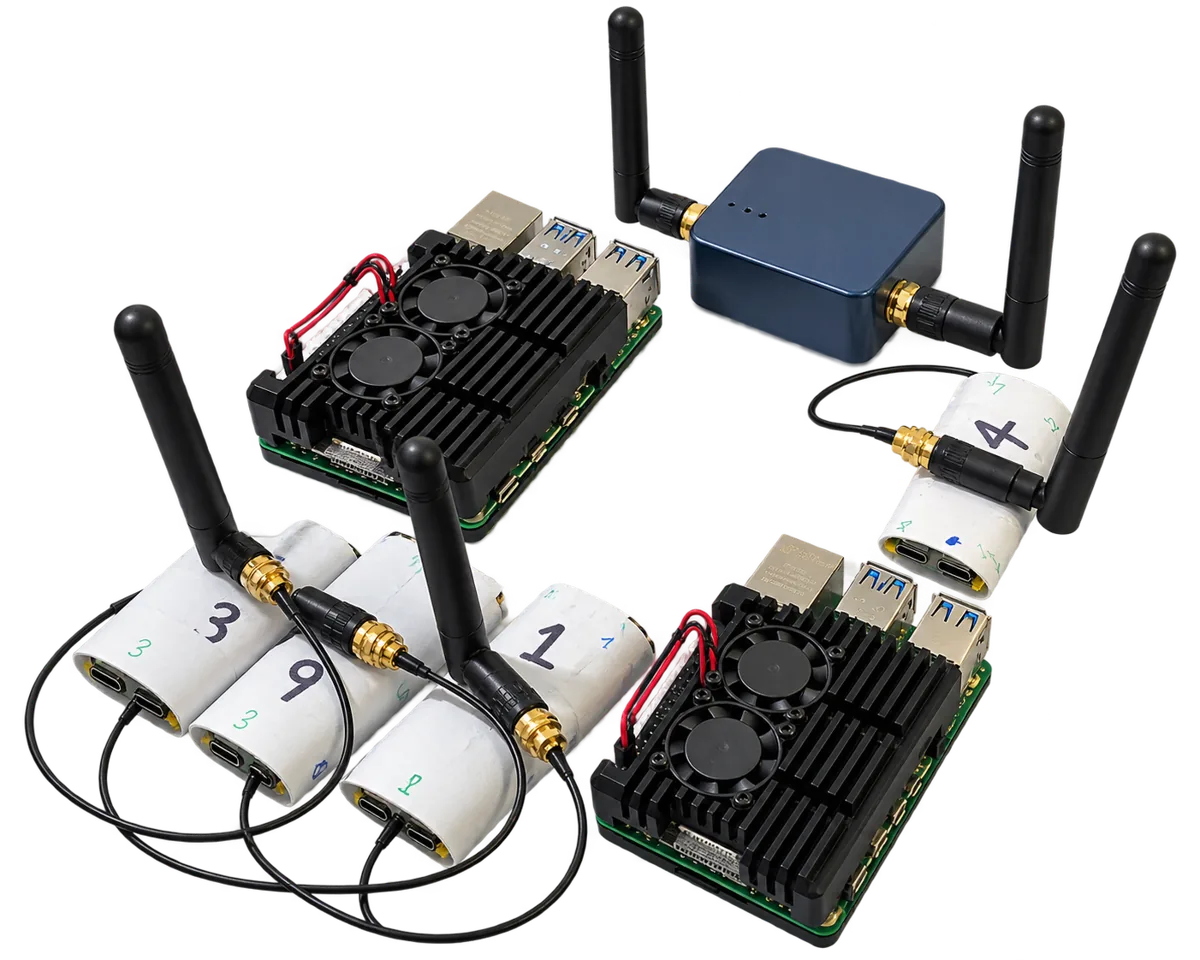
A small travel router makes the Wi‑Fi. Six ESP32 boards, tiny Wi‑Fi chips the size of a matchbox, sit around the room on USB power. A Raspberry Pi next to the router sends them a steady stream of little packets and collects what they measure.
A second Pi with a camera, the YoloPi, can watch the room to check the radio's answers. Everything is controlled from a web dashboard on the Pi.
Not a laser beam. A room full of echoes.
The tidy picture has the router "talking" to each sensor in a straight line, and a person breaking that line. Reality is messier. Every sensor hears the whole room: the direct signal plus echoes off walls, the floor, furniture and people, mixed together.
Each reading splits Wi‑Fi into 52 small channels, and every channel mixes those echoes differently. So when someone moves, the pattern shifts everywhere, sometimes most at a sensor on the other side of the room.
Ten hours of very noisy Wi‑Fi
The room was recorded empty and with someone inside: 22 recordings over 3 days. Two things made it hard. The sensors only managed 6–11 readings a second out of the 100 packets sent.
Worse, the setup moved between recordings. In the chart, the empty room suddenly looks completely different after lunch on 23 March, with nobody in it. To a computer, that looks just like a person walking in.
The simple one won
Complex models that looked at each sensor separately scored almost perfectly on the day they were trained on, then failed on new days. They had memorised where things were, not whether someone was there.
The best model asks only one question: how much are the most-shaken sensors shaking? Tested on a day it had never seen, it gets 84% right. It catches most people (99–100% on two of the three days), but still raises a false alarm in about 1 in 5 "empty" moments. Some may be real: someone could have come in while I was away, and Wi‑Fi passes through walls, so it may sense a person next door.
Sometimes you can see someone breathe
When a person sits still, their chest moves a few millimetres about 15 times a minute. That leaves a slow ripple in the Wi‑Fi. Filter out everything faster and slower, and sometimes a clear breathing rhythm appears.
Often it doesn't: a small movement or a passing person drowns it. So the breathing page runs four checks and only shows a number when all of them agree. Otherwise it says "not sure".
Every activity has its own Wi‑Fi fingerprint
works · 84%
built, not wired in
next step
idea
sometimes works
by design